Home About Case Studies Contact

VW Hatch Spoiler Product Development

Year
2024-2026

Roles
Product Research
Reverse Engineering
Prototype Development
Manufacturing Process Design
Production Validation
Market Validation
Ecommerce Planning

A discontinued automotive component became an opportunity to explore the complete product development lifecycle from research and prototyping to manufacturing, quality control, and eventually ecommerce.


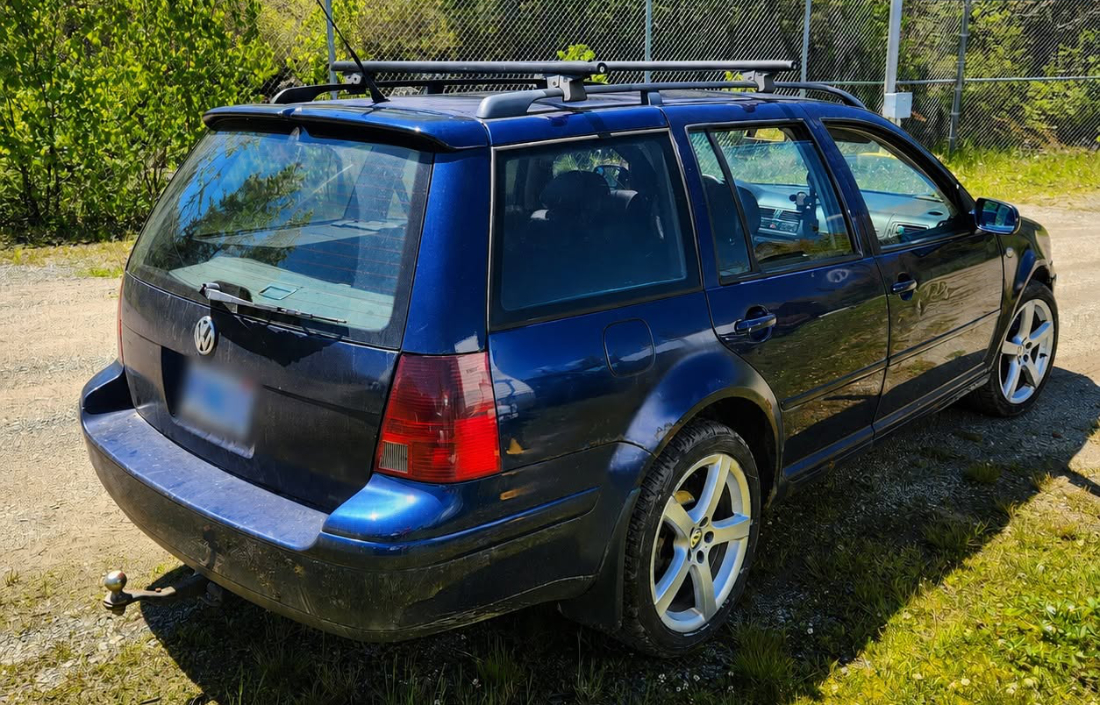
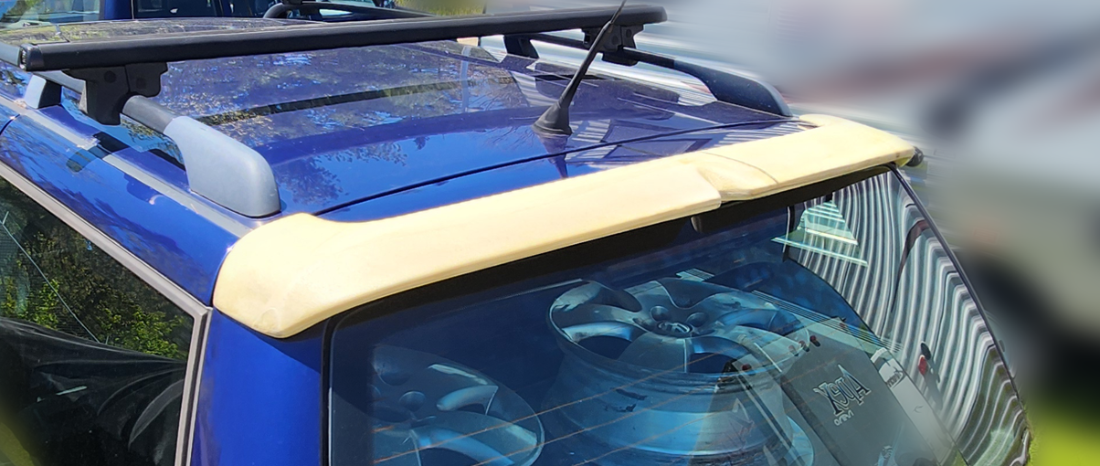
Prototype spoiler installed during fit and production validation.

Project Overview


The Challenge

The original OEM spoiler has been discontinued for more than twenty years, leaving owners with limited replacement options and an increasingly scarce supply of used parts.

The challenge was to recreate the part while designing a repeatable manufacturing process capable of producing consistent results in small production runs.

Goals

  • Accurate reproduction
  • Repeatable process
  • Small-batch manufacturing
  • Validate market demand

Project Constraints

Limited budget and available shop time meant every prototype needed to validate a specific assumption before moving to the next iteration.

The project emphasized learning and repeatability over rapid production.

The Process

Research

  • Analyze OEM geometry and mounting points
  • Plan mold separation
  • Evaluate material choices and production constraints
  • Plan for repeatable small-batch manufacturing

Prototype Development

Starting with an original spoiler, I created fiberglass molds and produced multiple prototype iterations.

Each revision revealed opportunities to improve:

  • Mold construction
  • Material selection
  • Consistency
  • Finishing process
  • Repeatability

The result was an evolving production workflow rather than a single finished prototype.

Each iteration was treated as an MVP, validating assumptions before investing additional time and materials into the next revision.

Product to Platform

The project naturally expanded beyond physical manufacturing.

Planning for future sales required thinking through branding, product presentation, ecommerce workflows and fulfillment, connecting a physical product with a digital customer experience.

(The ecommerce platform is currently planned as a future phase, pending local market validation.)

Strategic Takeaways

  • Validate assumptions before investing heavily
  • Iteration improves both product quality and process reliability
  • Manufacturing benefits from the same systems thinking as software
  • Small MVPs reduce risk while revealing better long-term solutions


Research & Reverse Engineering


The Problem Space

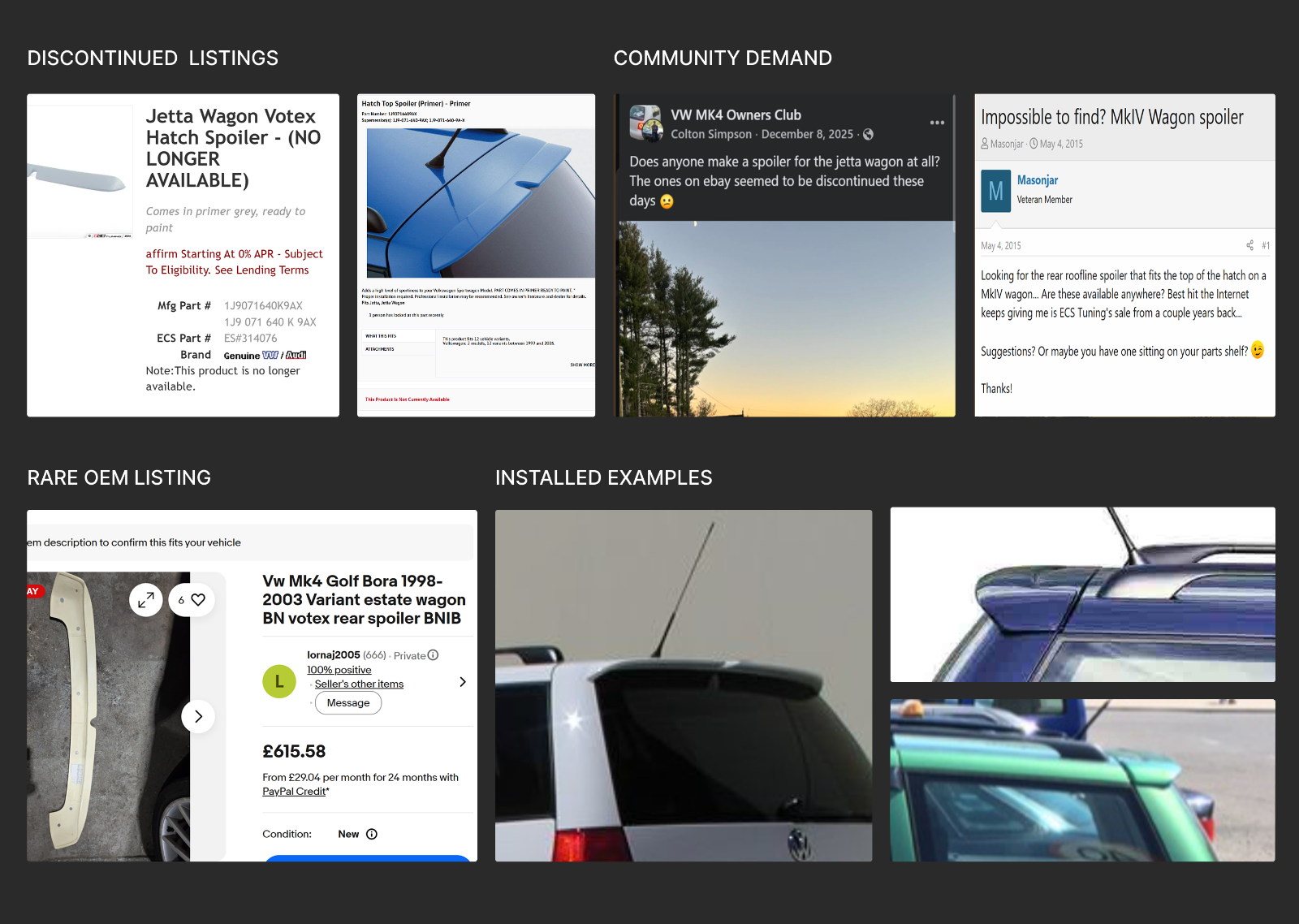
Before designing a solution, I researched the availability of the original OEM spoiler. The investigation quickly showed that genuine parts had been discontinued for more than twenty years. Existing examples were scarce, documentation was limited, and enthusiasts frequently discussed the difficulty of locating original components.


Research findings: Discontinued product listings, community discussions, and the limited number of surviving installed examples highlighted both the rarity of the OEM part and the need for an accurate reproduction.


OEM Part Analysis

  • Obtained an original OEM spoiler
  • Documented geometry
  • Studied mounting features
  • Measured critical dimensions
  • Determined mold split locations

Prototype Development

The first mold successfully demonstrated that the part could be reproduced, but the manufacturing process produced inconsistent wall thickness because the expanding material filled primarily from one direction. Rather than accept a "good enough" result, I documented the areas to improve and redesigned the tooling.

  • Deformation caused by insufficient mold reinforcement
  • Uneven material expansion during casting
  • Inconsistent wall thickness
  • Limited back-pressure ventilation
  • Excess finishing required
  • Process lacked repeatability
Tooling Redesign

The tooling was redesigned to address the limitations of the first iteration. The new mold and process dramatically improved the output consistency and reduced finishing work.

  • Reinforced mold structure
  • Positive alignment latching system
  • Rotational casting jig
  • Improved pressure distribution
  • Better surface quality
  • More repeatable casting process
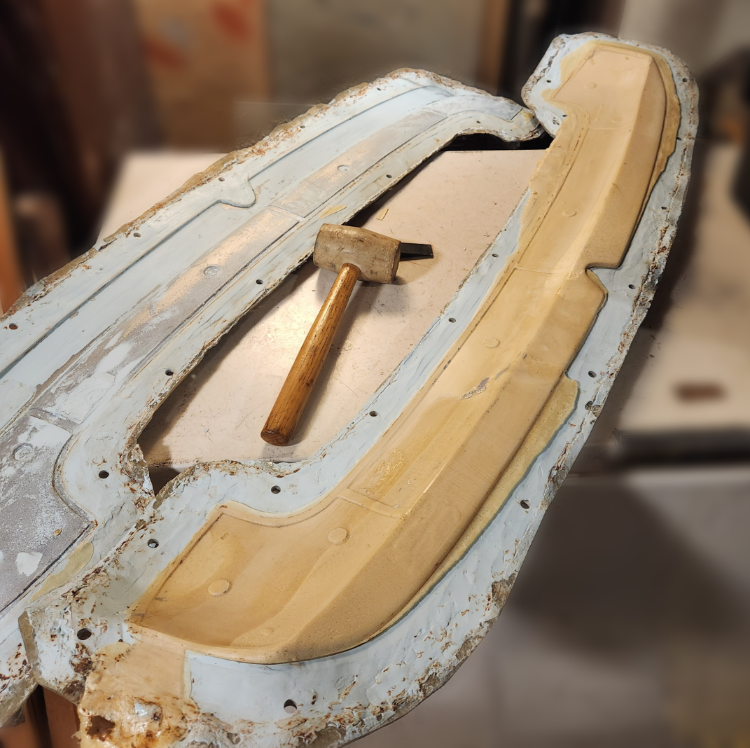
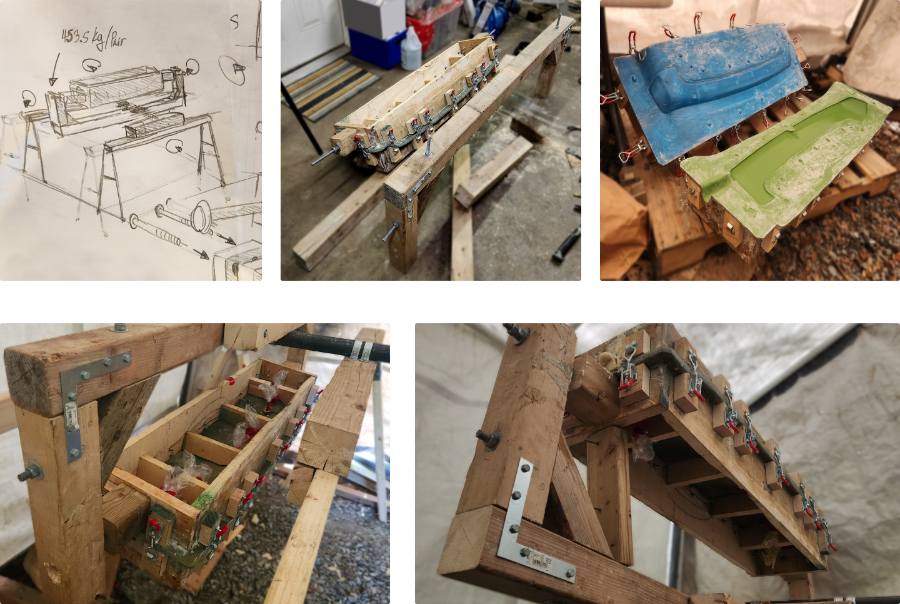
Reinforced spoiler mold mounted in the rotational casting jig
Second-generation tooling developed to improve casting consistency, mold alignment, and repeatability.


Production Validation


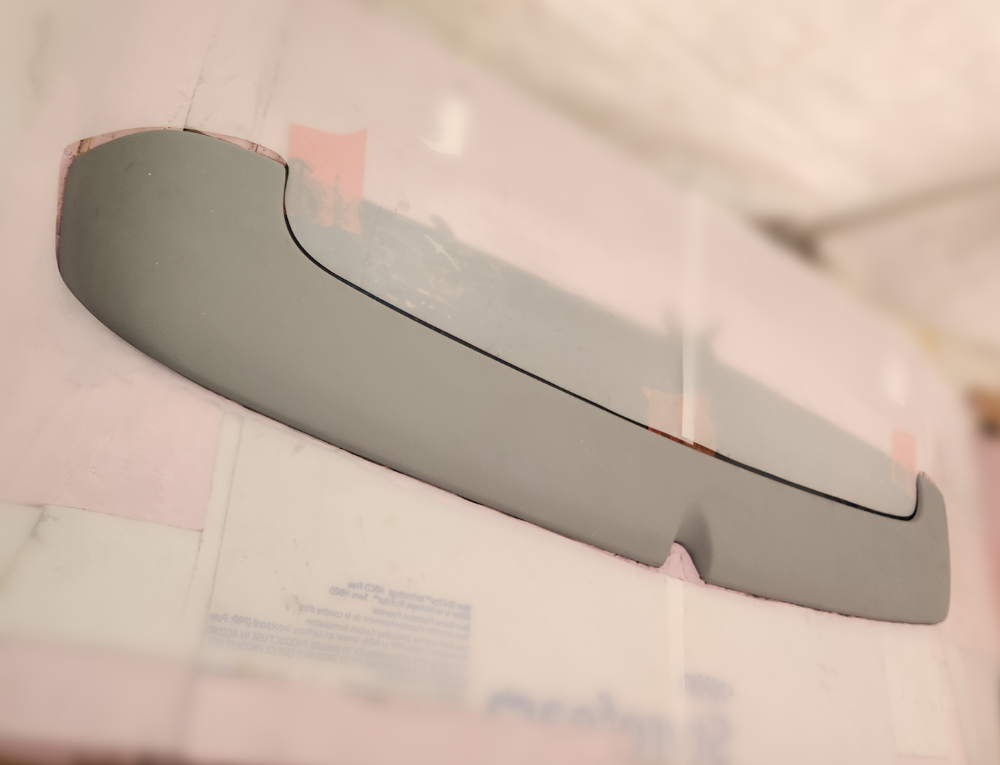
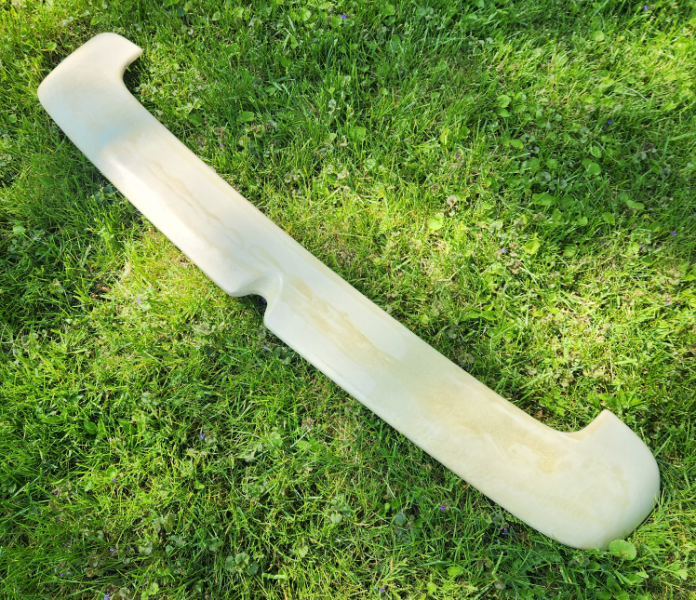
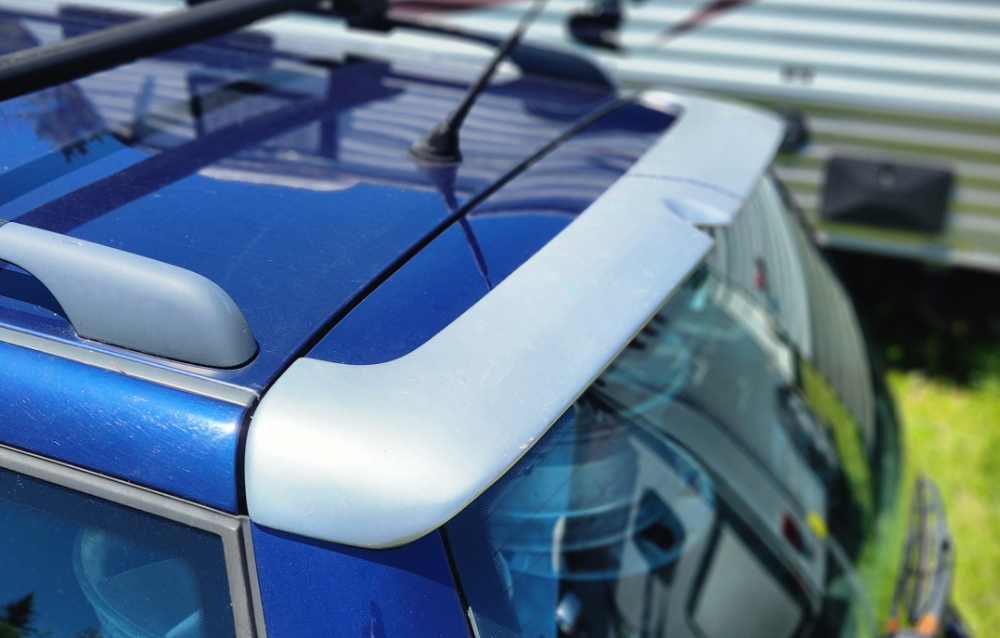
The redesigned tooling produced significantly more consistent castings while reducing finishing work and improving repeatability. Test fitting confirmed the revised geometry aligned with the original hatch profile and validated the manufacturing process before moving toward small-batch production.


Prototype test fit validating geometry, alignment, and overall fit prior to final finishing and paint.


  • Consistent casting geometry
  • Improved fitment
  • Reduced finishing work
  • Repeatable manufacturing process
  • Ready for small-batch production

Design Insight

The greatest improvement wasn't the spoiler itself—it was improving the manufacturing process. Treating the tooling as an evolving product transformed a one-off prototype into a repeatable production workflow.


Looking Ahead


Successfully reproducing the original spoiler established a repeatable development process that can now be applied to original designs.

With that foundation in place, I began exploring new spoiler concepts with a slightly longer profile and more aggressive styling while maintaining compatibility with the original hatch.

Future iterations will incorporate 3D scanning, CAD modeling, and rapid prototyping to shorten development cycles and explore new product ideas more efficiently.

While local product validation was the initial objective, the broader vision includes a dedicated ecommerce platform to support small-batch manufacturing and direct-to-customer sales.

Reflection


This project reinforced how closely physical and digital product development mirror one another. Research, iteration, testing, production constraints, and continuous refinement were equally important throughout the process.

Building a successful product required more than reproducing a discontinued component. Developing a repeatable workflow—from research and reverse engineering through tooling, validation, and refinement—proved just as valuable as the finished spoiler itself. The same iterative approach applies whether designing physical products or digital experiences.

Case Studies

PRODUCT DESIGN   ●   EDTECH


Binogi

Improving how students discover and engage with learning content
Read More

PRODUCT DESIGN   ●   EDTECH


Binogi

Improving how students discover and engage with learning content
Read More

WEB DESIGN   ●   AGTECH


Resson Ag-Tech

Redesigning the digital presence of an agricultural technology company
Read More

WEB DESIGN   ●   AGTECH


Resson Ag-Tech

Redesigning the digital presence of an agricultural technology company
Read More

WEB REDESIGN   ●   MINETECH


Scient Analytics

Modernizing the website and branding of a mining technology company
Read More

WEB REDESIGN   ●   MINETECH


Scient Analytics

Modernizing the website and branding of a mining technology company
Read More